

Industrial Park
Communication Modenization
Enhance Safety, Efficiency and Connectivity
Access the Park
Sofeno delivers SIP-based communication solutions for industrial parks, enabling centralized management of broadcasting, paging, intercom and emergency communication services across multiple facilities and operational areas
Why Industrial Park Communications Need Modernization
Modern industrial parks are no longer just collections of individual buildings. They are shared operational environments that bring together office buildings, service centers, warehouses, roads, gates, parking areas, public spaces, and multiple tenants or operational teams.
As industrial parks grow, communication requirements become more complex. Property management, security teams, maintenance personnel, and tenant-facing staff all need reliable ways to coordinate daily operations, deliver public announcements, manage incidents, and respond to emergencies across both indoor and outdoor areas.
Communications Are Fragmented Across Buildings and Public Areas
Office buildings, service centers, roads, gates, parking areas, warehouses, and public spaces often rely on separate communication systems, making park-wide coordination difficult.
Public Areas and Outdoor Zones Need Reliable Coverage
Roadways, entrances, loading areas, parking zones, and outdoor common spaces require reliable communication coverage for announcements, visitor guidance, and emergency notifications.
Daily Operations Involve Multiple Teams and Tenants
Property management, security, maintenance teams, and tenant-facing staff all need to coordinate routine notices, service requests, and incident handling across different buildings and operational areas.
Legacy Systems Make Park-Wide Management Difficult
Older amplifiers, building-level PA systems, and isolated communication devices are difficult to integrate, scale, and manage as the industrial park expands or upgrades its services.
What This Solution Helps You Achieve
The SOFENO Industrial Park Communication Solution helps park operators move from isolated building-level systems to a centralized SIP-based communication platform for public announcements, operator coordination, help point communications, and emergency notifications.
By connecting buildings, entrances, public spaces, service areas, and operator positions into one unified architecture, the solution improves daily park operations while supporting future expansion and practical modernization of legacy infrastructure.
Centralized Park-Wide Paging and Public Announcements
Broadcast notices, visitor instructions, operational messages, and emergency alerts across office buildings, public areas, roads, entrances, and shared facilities from one unified platform.
Faster Emergency Notifications Across the Park
Deliver urgent instructions quickly to buildings, public spaces, entrances, and outdoor areas during incidents such as fire alarms, security events, or evacuation scenarios.
Better Coordination Between Operations, Security, and Property Teams
Enable direct communication between management offices, security posts, service counters, maintenance teams, and operator consoles for daily coordination and incident response.
Practical Modernization of Existing Communication Infrastructure
Integrate suitable existing amplifiers, speakers, and analog paging systems while gradually introducing SIP-based platforms, intercoms, and IP endpoints across the park.

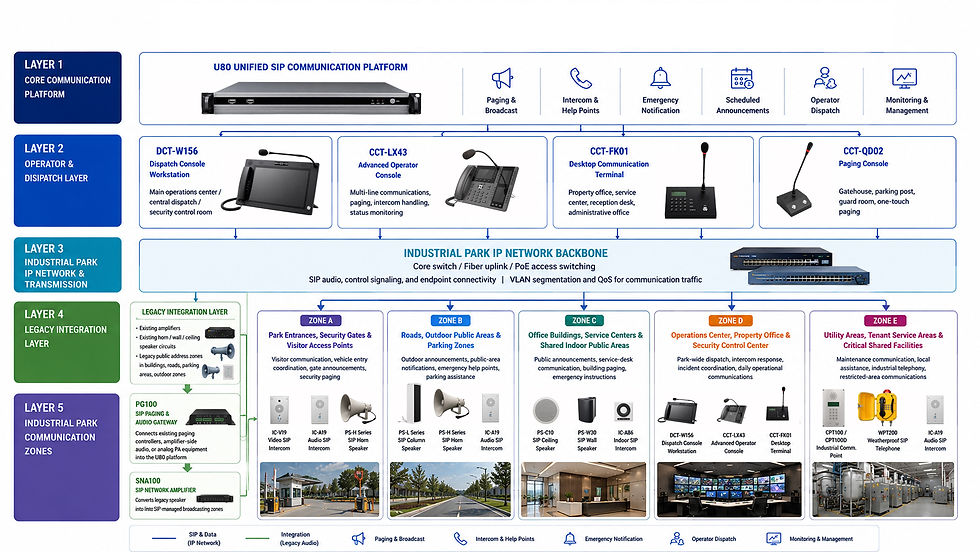
Industrial Park Communication Modernization Architecture
This proposal outlines a hybrid, future-ready SIP communication solution designed for industrial parks, business campuses, logistics parks, and multi-building mixed-use operational sites. The architecture combines park-wide broadcasting, intercom communications, emergency notification, and operator dispatch into one unified platform, while also supporting phased modernization of legacy analog paging and communication infrastructure.
The solution is built around SOFENO U80, a unified SIP communication platform that serves as the central system core for paging, intercom, dispatch, scheduled broadcasting, emergency response, and endpoint management. By combining native SIP endpoints with legacy integration devices, the platform allows industrial parks to preserve suitable existing amplifiers, speaker circuits, and analog public address infrastructure where practical, while expanding into new office buildings, entrances, outdoor public areas, parking zones, and service facilities with modern IP-based communications.
The result is a scalable industrial park communication architecture that supports both asset preservation and digital expansion, enabling park operators to modernize communication systems step by step without losing centralized control over daily operations, tenant services, public-area communication, and emergency response.
Key Capabilities
The solution combines centralized paging, public-area broadcasting, SIP intercoms, operator communications, and legacy system integration to support both daily industrial park operations and emergency response across multiple buildings and outdoor areas.
This allows industrial parks to improve communication consistency, coordinate more efficiently across teams and public spaces, and build a scalable communication platform that can grow with the park over time.
Centralized Paging and Public Notifications
Manage park-wide announcements, visitor guidance, operational messages, and emergency communications from one centralized communication platform.
Zoned Communications Across Buildings and Outdoor Areas
Deliver targeted messages to specific office buildings, gates, roads, parking areas, service zones, or public spaces without affecting the entire park.
Help Point, Intercom, and Operator Communications
Support visitor assistance, security communications, service counters, and daily operational coordination through SIP intercoms and operator terminals.
Legacy Integration and Scalable Deployment
Connect suitable existing PA infrastructure into the SIP communication system and expand communications across new buildings and public areas over time.


